Route no. 5 · start & finish Can Pastilla
Formentor
- Epic
- 210 km
- 1,906 m
- ≈ 8–10 h
Map and elevation profile
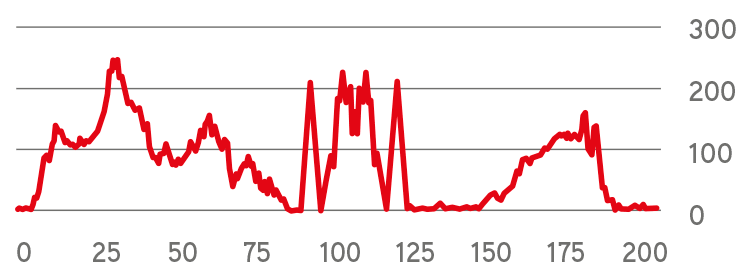
Move along the elevation profile to see where you are on the map.
Food & coffee stops
Tried-and-tested places where cyclists like to stop for coffee, food or water.
-
Restaurant 36 kmCal Dimoni Algaida
Well-known wood-grill restaurant on the old Palma–Manacor road as you enter Algaida: coffee on the terrace, or grilled sobrassada and arròs brut. Opens at 9 am, closed on Wednesdays.
Open in maps ↗ -
Café 68 kmBar Es Club Campanet
A well-known cyclists' stop on Campanet's main square facing the church, about 800 m off the route (a short detour into the centre) – try pa amb oli for breakfast. Closed on Mondays and Tuesdays.
Open in maps ↗ -
Restaurant 90 kmTolo's Port de Pollença
Walls full of cycling memorabilia, including Bradley Wiggins' bikes and jerseys – the classic riders' stop before or after Formentor, on the Passeig de Londres seafront about 450 m off the route. Closed on Mondays.
Open in maps ↗ -
Café 110 kmCafetería Far de Formentor Cap de Formentor
Coffee at the lighthouse, the turnaround point at the end of the road. Seasonal, roughly March–October, 10 am–4 pm, and sometimes closed – don't count on it.
Open in maps ↗ -
Café 152 kmBar 9 Jovent Sa Pobla
Bar with a kitchen where the route enters Sa Pobla from Alcúdia (Camí de l'Albufera), right by the route – look for the big mural on the façade. A long-time cyclists' stop for coffee, tapas or a cold beer. Opens 6am Mon–Fri, 7am Sat, not until 3pm Sun.
Open in maps ↗ -
Café 183 kmCafè Comerç Santa Maria del Camí
Long-established cyclists' café on Plaça dels Hostals, right on the route about 27 km from the finish: coffee, homemade cakes, pa amb oli and tools at the back for small repairs. Opens 6am (7am at weekends), closed Thursdays.
Open in maps ↗
Cap de Formentor, Mallorca’s Cycling Paradise
Route summary:
This route over Cap de Formentor is known as the Royal Stage as it is the longest and takes you to the most northerly point of the island. This trip is only for experienced riders. It should be the peak of your cycling holiday and will require some serious preparation. The whole trip takes between 7 and 10 hours depending on your average speed. We recommend stopping at Cap de Formentor to recover some energy for the way back and to ensure you do not miss the opportunity to enjoy the great views. You can stop in many of the towns on the route, such as Llucmajor, Inca, Pollenca, Alcudia, and Santa Maria del Camí. The terrain is slightly undulating. The most demanding part comes after you have passed through Pollenca where, in the north part of the island, there are hills to be climbed. Along the way, you can enjoy the views of the Tramuntana highlands and especially the part when the land meets the Mediterranean Sea.
 Cycling route summary:
The route starts with a slightly hilly profile to the town Llucmajor. It is followed by a shorter uphill around Randa to Algaida. A long flat section follows from Algaida through Inca, along the edge of the Tramuntana Mountains. This part of the route on beautiful roads will take you to Pollenca. The most difficult section will be starting at Port de Pollenca and finishing at Cap de Formentor. You will first experience an intense 5-kilometer climb, then a descent and then a slight uphill to the northernmost tip of Mallorca. The last section encourages you to compete against your friends. It will be necessary to climb the hills, you descended when coming to Cap de Formentor, on your way back. You will then take an easy journey along the north coast to Alcudia, followed by the flat road to Can Pastilla. You will ride through Sa Pobla and Santa Maria del Camí on typical Majorcan roads between local vineyards. You will enjoy the breathtaking views of the Tramuntana Mountains on the way.
 Tourist summary:
The start and end of this route are in Palma Aquarium. The route leads to the northernmost tip of Mallorca, Cap de Formentor. The inland mountains meet the Mediterranean Sea here. It is an iconic route. Someone would say "who wasn’t at Formentor, as if he wasn’t in Mallorca".
Climbs click to show on the map
- Coll de sa Creueta (Mirador des Colomer) from Port de Pollença 3.1 km · Ø 6.3 % · max. 8.2 % · top 208 m km 93–96
- Cap de Formentor (Far de Formentor) from Platja de Formentor 7.1 km · Ø 3.2 % · max. 7.3 % · top 221 m km 100–107
- Coll de sa Creueta (Platja de Formentor) from Platja de Formentor 3.5 km · Ø 5.8 % · max. 8.8 % · top 208 m km 121–124
Tips from our guides
- Start at first light: 210 km means 7–10 hours on the road. Carry food for the whole day plus front and rear lights.
- On the way to the lighthouse you ride through a tunnel of about 300 m. Switch your lights on and take off your sunglasses before entering.
- In the main season the road from Formentor beach to the lighthouse is closed to private cars during the day. Bikes may ride it, but buses and taxis still run.
- Fill both bottles in Port de Pollença. Don't rely on refills on the Formentor peninsula – the beach and lighthouse cafés keep seasonal, changeable hours.
- Locals call the cape the meeting point of the winds. Expect gusts on exposed ridges, descend with care and watch out for goats on the road.
Did you know?
- The Formentor road dates from 1925 and was the work of engineer Antoni Parietti – the same man who later built the famous Sa Calobra road. source
- Pollença-born poet Miquel Costa i Llobera, who owned the Formentor peninsula, wrote 'El pi de Formentor' (1875) about a pine clinging to its cliffs – his best-known poem. source
- Alcúdia's old-town walls were completed in 1362; just outside them lie the ruins of Roman Pollentia, founded after the Romans took Mallorca in 123 BC. source
Places along the route
-
126 km
Llucmajor
It is the largest city on the island in terms of its wide area, however the town itself has fewer than 12,000 inhabitants (the whole municipality over 40,000). The first historical records of the city date back to the 13th century. Definitely the most interesting historical event is the Battle of Llucmajor. It was a part of the war of independence of the Mallorca Kingdom in 1349.
Important city industry today includes tourism and footwear production.
The most famous monuments of the city are the Town Hall, the Church of St. Michael from the 18th century on Plaça Santa Catalina Tomàs and the monument of James III - Passeig Jaume III. Jaume III. fell in a memorable battle in the war for independence.
-
235 km
Algaida
Algaida has a population of 4,500. The origin of the name can be found in Arabic. It means "the forest".
The first written records date back to 1232. The city's sights are the Mare de Déu de la Pau de Castellitx, pilgrimage chapel and several windmills. The city also has the oldest glass blowing factory in Mallorca. You can still see the local glassmakers producing art objects in the workshop of the Gordiola family.
-
341 km
Pina
Pina is a small town. It is named after the hero Ferdinand Pina from the conquest battles. Its main attractions are the churches of San Cosme and San Damian, the Cross and Convent.
-
448 km
Sencelles
This area has been populated for thousands of years, as evidenced by the archaeological sites.
The area developed greatly in the second half of the 19th century thanks to wine growing. Unfortunately, the vineyards were destroyed by a pest at the end of the 19th century. However, the area has managed to recover and we can find there the most famous vineyards in Mallorca.
One of Mallorca's most popular public figures was Sister Francinaina Cirer (1781 - 1855), beatified by Pope John Paul II. She was born right here.
-
557 km
Inca
Inca is the third largest city in Mallorca. We can find Roman and Muslim settlements in the city history. Inca is called the kingdom of the leather. The tradition of leather processing dates back to 1871. The Camper brand is still well known.
There is a "Leather Market" every Thursday.
The city landmark is the Santa Maria la Mayor church. You can also visit several local monasteries. Tourists are welcome.
-
668 km
Campanet
The original pueblo, today a town with 2,600 inhabitants. It is usually not on every tourist list, so its atmosphere is slightly sleepy.
The town is known for its springs, supplying the city's wells. The production of footwear had a big traditional here.
The parish church of the Immaculate Conception from the 18th century, will welcome you at the main square.
-
770 km
Coves de Campanet
There is a cave, near Campanet, discovered by a man who dug a well here in 1945. Part of the cave complex is an underground lake.
-
883 km
Pollenca
A small town just a few kilometers from the Port De Pollensa. Town of narrow streets, stunning main square, many cafes, restaurants and bars.
You can see many artists all around the city. Writers and musicians are looking for some inspiration there.
The city’s landmark is the old Roman bridge, Pont Romà and the main square Placa Mayor.
You can climb 365 steps to the El Calvari chapel, or take part in a never ending debate with the locals. Historical attacks by pirates are a famous topic.
-
9110 km
Formentor
A magical place on the halfway of the route. The lighthouse, not accessible to the public and beautiful sea views from north part of the island.
-
10138 km
Alcúdia
This port is a very popular holiday destination. It has clean beaches, clear water and many hotels and restaurants.
There are many cafés, bars, stylish boutiques and local shops in the pedestrian area.
Local markets are also very famous. They are held every Tuesday and Sunday. There is also the smallest Roman theatre in Spain.
-
11151 km
Sa Pobla
This town is known for its production of potatoes, but its history goes much further. The first notes date back to 183 BC. Archaeological excavations proof the settlement.
You can visit the 17th-century Church of Sant Antoni Abat, on the main square Placa de Esglesia.
There is the S ´Albufera Nature Reserve, close by, with thousands of birds.
-
12182 km
Santa Maria del Camí
The city is located in the heart of the wine region. The rich history of wine distribution and the view of authentic Majorcan villages, are an unforgettable experience when visiting the city, especially for wine lovers.
-
13189 km
Sa Cabaneta
A small town with a ceramic production tradition. But the most famous attraction is the local distillery. The traditional drink of the Mallorca, RON AMAZONA, is being produced there.
-
14201 km
S ´Aranjassa
A small village on the route between Palma de Mallorca and the airport. Although it is a small village, with only 1,000 inhabitants, you will find there traditional architecture buildings.
More routes
All routes →Rides of similar difficulty you might also like.