Route no. 10 · start & finish Can Pastilla
Port de Sóller
- Hard
- 123 km
- 1,962 m
- ≈ 5–6½ h
Map and elevation profile
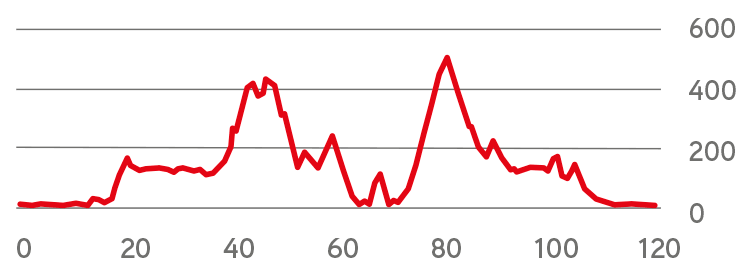
Move along the elevation profile to see where you are on the map.
Food & coffee stops
Tried-and-tested places where cyclists like to stop for coffee, food or water.
-
Café 25 kmCafè Comerç Santa Maria del Camí
Long-standing cyclists' stop on Plaça dels Hostals, with tools at the back for small repairs. You pass it at km 25 and again at km 99. Closed on Thursdays.
Open in maps ↗ -
Café 44 kmBarbaflorida cafè Valldemossa
Speciality coffee and homemade cakes right next to the Cartoixa, just after the top of the climb. Closed on Tuesdays and Wednesdays.
Open in maps ↗ -
Café 70 kmBar Oceà Port de Sóller
Bar on the Es Través promenade right next to Hotel Eden, on the sunny side of the bay, about 1 km off the route along the seafront from Repic beach: coffee, fresh juices and smoothies, wraps and baguettes on a terrace overlooking the harbour. Open daily from 10am.
Open in maps ↗ -
Restaurant 70 kmPatiki Beach Port de Sóller
Beach restaurant at the western end of Platja d'en Repic, right on the route (km 67 and 70): seasonal cooking with local produce, grilled fish and salads to share. Great for lunch before the Coll de Sóller climb – we recommend booking. From noon; closed in winter.
Open in maps ↗ -
Café 82 kmCa'n Topa Coll de Sóller (Bunyola)
Café at the top of the Coll de Sóller (497 m), right by the pass sign at the end of the 9 km climb from Sóller: freshly squeezed juice from Sóller oranges, homemade cakes and baguettes. Usually opens at 11am, closed on Wednesdays; hours change (it may take a summer break), so check before you go.
Open in maps ↗ -
Café 90 kmBar Central Bunyola Bunyola
Village bar and grill on the Sant Mateu church square in the centre of Bunyola, right on the route: coffee from 7am, tapas and grilled dishes on the terrace. Closed Mondays; Tue–Fri afternoon break 4–6.30pm.
Open in maps ↗
A Mountain Stage to the Charming Sóller
Route summary:
This beautiful mountain stage with an almost 2,000-metre climb is one of the most difficult rides in Mallorca. The elevation of the terrain is suitable for developing strength and endurance, and is only recommended to experienced riders. The whole route will take between 5.5 and 7 hours depending on your average speed. The crucial part of the trip is the climb to Coll de Sóller around the famous orange and lemon gardens. The best place to stop is Santa Maria del Camí, which is known for its great wine. Then there is Valldemossa with its Carthusian monastery, and Deià with its picturesque old houses and lovely cafés. Coffee fans will welcome a stop in Port de Sóller, where you get a great view to the Sa Creu lighthouse. Bunyola will charm you with its terraced gardens set in beautiful nature with the surrounding Tramuntana highlands.
 Cycling route summary:
The initial kilometers of the route are completely flat. The first short, but intense climb to Santa Maria del Camí comes after 17 kilometers. The following 20 kilometers, from Santa Maria del Camí to the Tramuntana Mountains are flat again. Challenging climb to Valldemossa follows after. You will be rewarded with a breathtaking scenery on the way from Valldemossa to Port de Sóller, on the west coast of the island. It has a slightly descending profile. The most difficult section waits for you at the main destination of this route. It is an ascent to the Coll de Sóller, along the orange and lemon groves. The 8 kilometers of climbing is an ideal place, to gather the last energy into a final push, to compare yourself with your friends. You will then do a pleasant descent between olive groves from Coll de Sóller down to inland. However, the road is sometimes slippery, because of the olive trees around, so it is important to be extra careful. Please pay attention, especially in the turns. The remaining flat 30 kilometers will take you back to Can Pastilla.
 Tourist summary:
The route to Port de Sóller will mainly take you through the west coast mountains of the island. You will do a series of difficult climbs, followed by the beautiful seaside scenery.
Climbs click to show on the map
- Valldemossa (Ma-1110) from Son Maxella (Ma-1110) 6.1 km · Ø 4.7 % · max. 9.8 % · top 413 m km 38–44
- Coll de Sóller from Sóller (Ma-11) 8.9 km · Ø 5.3 % · max. 9.5 % · top 497 m km 73–82
Tips from our guides
- The Ma-1110 up to Valldemossa and the coast road to Deià carry lots of cars and tour coaches. Start early, ride single file and keep right.
- Bikes are not allowed in the Sóller road tunnel, so the route takes the old pass road over Coll de Sóller: narrow, closed to heavy vehicles and with very little traffic.
- Refill your bottles in Port de Sóller or Sóller. The 8.9 km climb has no reliable refill point until Ca'n Topa at the top.
- The descent to Bunyola has about 25 hairpins, often shaded and sometimes slippery. Brake before each bend and pack a light gilet, as it gets cool at 500 m.
- Both main climbs average about 5%, with short ramps near 10%, so a compact chainset is enough. Save your legs for Coll de Sóller, which starts at km 73.
Did you know?
- The English poet Robert Graves first moved to Deià in 1929 and is buried in the small churchyard on the hill above the village. source
- Valldemossa is the birthplace of Saint Catalina Thomàs (1531), canonised in 1930. Look out for the plaques in her honour on many houses. source
- The historic Palma–Sóller railway was paid for by the then-booming orange and lemon trade. It runs through 13 tunnels under the mountains you ride over. source
Places along the route
-
123 km
Santa Maria del Camí
The city is located in the heart of the wine region. The rich history of wine distribution and the view of authentic Majorcan villages, are an unforgettable experience when visiting the city, especially for vine lovers.
-
244 km
Real Cartuja de Valldemossa
A magnificent Carthusian monastery, built in the 14th century, on the ancient Moorish Alcázar. This peaceful environment has offered spiritual inspiration to Carthusian monks, for more than four hundred years. The world-famous pianist Frédéric Chopin and writer George Sand spent the winter of 1838-1839 there. The room they rented that time is now open to the public.
The large monastery lands also include the 14th-century Palacio Rey Sancho, built by King Jaume II for his son Sancho.
-
351 km
Son Marroig
The stunning estate with the coastline view, was the residency of the Austrian Archduke Ludwig Salvator in 1870. He built there the marble pavilion, on the cliffs, just above the sea. The sea and garden view are unforgettable.
-
454 km
Deià
The town name comes from the Moorish conquest of Mallorca time. It dates between the 10th and 13th centuries. Muslims called the area "Ad-Daya", which means "village".
Muslims created the terraced irrigation systems, that allowed the development of agriculture, despite the large number of steep slopes. The landscape around Deià is shrouded with olive trees and honey-colored houses. It shows one of the most traditional villages in Mallorca.
-
566 km
Port de Sóller
The historic tram (Tranvía de Sóller), operating since 1913, is an integral part of this port village. You can see both the harbor and the Tramuntana Mountains from the train cabin. The charming natural scenery makes the port to be a very popular tourist destination.
-
668 km
Far des Cap Gros
One of the two lighthouses marking the entrance to the port of Sóller. It was built in the 19th century. It worked for many years, without the necessary lighting, as the indication for the arriving ships.
-
790 km
Bunyola
Bunyola could be described as the diverse nature, as far as your eye can see. You will pas through the ovlive plants on the south. There are large number of manors in the northern part, at the foot of the mountains. The most famous are Alfábia and Raixa. Their terraced gardens date back to the Arab period.
More routes
All routes →Rides of similar difficulty you might also like.