Route no. 13 · start & finish Can Pastilla
Sant Salvador
- Medium
- 130 km
- 1,117 m
- ≈ 5–6 h
Map and elevation profile
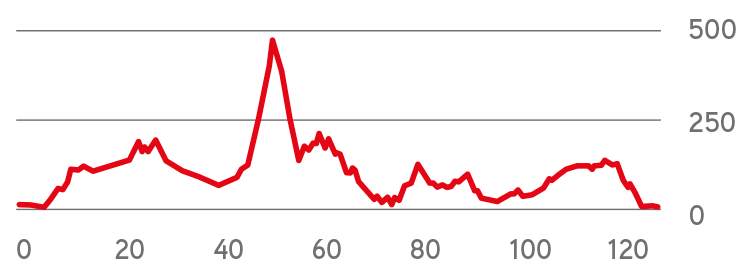
Move along the elevation profile to see where you are on the map.
Food & coffee stops
Tried-and-tested places where cyclists like to stop for coffee, food or water.
-
Café 31 kmBar ca'n Guillem Porreres
Sunny terrace on the main square with bike racks; cyclists are expressly welcome and it opens early – in the centre, about 600 m off the route.
Open in maps ↗ -
Café 50 kmCan Calco 510 (Sant Salvador Cafetería) Santuari de Sant Salvador
Terrace café inside the sanctuary complex at the top of the climb – a well-earned coffee with views over the south-eastern plain, open daily.
Open in maps ↗ -
Café 85 kmSa Plaça Santanyí
Café-restaurant on the main square among golden sandstone houses, about 500 m off the route – a relaxed break at km 85 before the last 45 km.
Open in maps ↗
Cycling Mecca and the Sant Salvador Monastery
Route summary:
This route takes you to the top of Puig de Sant Salvador, and along the way you will pass various historical monuments. As there is one major 5-kilometre climb, it is considered to be an intermediate-level route. It is suitable for high-volume training even for a group of intermediate riders. It takes between 4.5 and 6 hours depending on your average speed. The flat scenery in the eastern part of the island and the climb to Sant Salvador Monastery with its statue of Jesus Christ, which is over 7 metres high, is one of the most popular destinations for cyclists. It will come as no surprise that you can also find some World Championship jerseys there. Along the way, you can take a break in historical towns like Porreres and Felanitx, or enjoy a great cup of coffee in the port town of Portopetro or the nearby Santanyí with many picturesque streets that are so typical for Mallorca.
 Cycling route summary:
The initial 45 kilometers going through the towns of Llucmajor and Porreres are flat/ slightly hilly. It is quite an easy part and allows you to gain some comfortable mileage, ideally if you ride in a group. The route switches into a longer climb from Felanitx to the top of Puig de San Salvador. You can see a number of breathtaking historical monuments there. For example a statue of Jesus Christ, the cross of Picot and others. You will also observe the flat landscape of the eastern part of the island. Nice descent back to the inland will come next. The route then gets back to be flat or slightly hilly, with just short and easy climbs. The last 2 hours of riding will take you from Santanyí back to your final destination . It has a pleasant flat profile and goes through the southeastern part of the island.
 Tourist summary:
The route will take you across the flat eastern part of the island to a roughly 5-kilometer climb to Puig de San Salvador. At the top you will find a breathtaking view of the local historical monuments and the surrounding landscape. After this unusual experience, the route will move to the east coast, specifically to the fishing village Portopetro.
Climbs click to show on the map
- Santuari de Sant Salvador from Felanitx 5.1 km · Ø 6.8 % · max. 9.2 % · top 489 m km 45–50
Tips from our guides
- The Sant Salvador climb is 5.1 km at 6.8% with 19 hairpins. The gradient is steady, so settle into a rhythm early. A compact chainset with a 28–30 sprocket is plenty.
- You descend the same road you climbed. Brake before each hairpin and keep right – cars and plenty of other cyclists are coming up.
- There is little shade on the south-eastern plain. In summer start early, carry two bottles and only drink from fountains marked 'agua potable'.
- From Portopetro via Santanyí to Campos (about 22 km) the route follows the Ma-19 main road, which carries plenty of holiday traffic. Ride single file and stay alert.
- After Campos, quiet lanes rise gently to about 125 m, then drop fast to s'Arenal. The summer sea breeze (embat) is strongest in the afternoon, so share the work in a group.
Did you know?
- The world champion jerseys at the sanctuary were donated by Felanitx-born Guillem Timoner, who won six world titles in motor-paced track racing between 1955 and 1965. source
- Felanitx is the hometown of painter Miquel Barceló (born 1957), who covered the entire Chapel of Sant Pere in Palma Cathedral with terracotta. source
- Santanyí's Sant Andreu church houses an organ that Jordi Bosch built in 1762 for Palma's Dominican monastery. It was moved here after the monastery was dissolved in 1837. source
Places along the route
-
117 km
Llucmajor
The location called "Capocorb Vell" is one of the best-preserved archaeological sites in Mallorca. The town records date back to 1259, when the first church was built there. It is also worth mentioning the battle of 1349, which ended the island’s independence.
The strong agricultural tradition is very specific for Llucmajor. It has been preserved to this day. Abundant orchards of apricots and almonds are visible throughout the city.
-
230 km
Porreres
Historical records of the city date back to the Bronze Age, and the Romans settled here later. The city was formally founded in 1300 and named after the city's conqueror William Porrer.
Porreres is very similar in its appearance to the surrounding small towns. It is specified by old stone buildings and a rustic atmosphere. The local Baroque church "Nostra Senyora de la Consolació" is very popular.
-
343 km
Felanitx
It’s a local, regional town. Its history dates back to the Bronze Age. This place is famous for its wine industry. There were more than 60 distilleries, in this area, in 1749.
Capers are also very famous locally. The main daily attraction is the city center market with a rich selection of local products.
The main historical monuments are the Castell de Santueri, the Monastery of San Salvador with the adjacent fortress and the Church of San Miguel.
-
450 km
Puig de San Salvador
The Temple of la Mare de Déu de Sant Salvador is a monastery from the mid-14th century. It was built to protect the city from the pandemic. People believed that altitude would keep the disease under control. The monastery is located on top of the Puig de Salvador and was completely renovated in the 18th century. You can see a Gothic altar and religious paintings inside the church.
Another historical monument at the top is the Monument of Christ. It was inaugurated in 1934. The 7-meter-high copper statue is part of a 37-meter-high monument and is a breathtaking viewpoint for the surrounding flat landscape. The 14-meter-long Picot Cross is also a wonderful place to observe the surrounding countryside. It is in a 15-minute walk away and offers views of the southeast coast, Santueri Castle and Cabrera Island on a nice day.
-
574 km
Portopetro
Place ideal for a coffee stop .You can see traditional buildings with authentic Mallorcan window blinds and a fishing port with a rich history.
-
684 km
Santanyí
Place with a peaceful atmosphere and lovely streets with golden sandstone houses. The city is an ideal place for artists. You will find a number of galleries there.
You can visit the Porta Murada gate, which is a reminder of the city's defense against a pirate invasion. The church had an important role in history. The locals were finding a shelter there, during the Moorish invasion.
-
796 km
Campos
The city was officially founded by King Jaume II, in 1300, based on the Roman settlements. The main monument of the city is the Church of Sant Julia with paintings of Jesus Christ. The author is the painter Bartolomé Esteban Murillo.
The famous local markets open every Thursday and Saturday. You can buy there some traditional specialties, like "Sobrasada and Piris" cheeses.
More routes
All routes →Rides of similar difficulty you might also like.