Route no. 14 · start & finish Can Pastilla
Can Picafort
- Hard
- 163 km
- 1,455 m
- ≈ 6–7½ h
Map and elevation profile
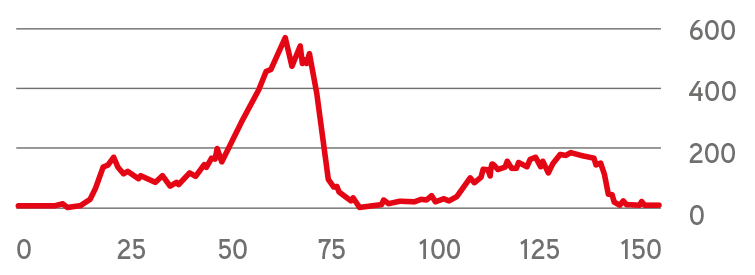
Move along the elevation profile to see where you are on the map.
Food & coffee stops
Tried-and-tested places where cyclists like to stop for coffee, food or water.
-
Café 60 kmRestaurant Coll de sa Bataia (Repsol) Coll de sa Batalla
Café at the summit next to the Repsol station, with bike racks, tools, a floor pump and water refills – the key stop before the descent to Pollença.
Open in maps ↗ -
Restaurant 85 kmTolo's Port de Pollença
Seafront café-restaurant full of cycling memorabilia, with bikes hanging from the ceiling, about 500 m off the route – the classic halfway lunch stop, closed Mondays.
Open in maps ↗ -
Restaurant 115 kmSa Fonda Muro
Family-run restaurant opposite the church in the centre of Muro, about 200 m off the route at km 115; over 100 road cyclists recommend it on Komoot. Coffee and breakfast in the morning, a buffet of Mallorcan home cooking at lunchtime; open 6:30–16:30, closed on Tuesdays.
Open in maps ↗ -
Café 127 kmPanord Sineu
Bakery-café with a terrace on Plaça Es Fossar by Sineu's church, about 230 m off the route at km 127: coffee, an ensaïmada, an empanada or pa amb oli. Open daily 6:30–20:00; on Wednesday mornings the market fills the square.
Open in maps ↗ -
Café 143 kmHostal d'Algaida Algaida
Roadside inn dating from 1961 on the old Palma–Manacor road, right on the route at km 142 with 21 km to go: coffee with an ensaïmada, pa amb oli or Mallorcan dishes such as tumbet and arròs brut. Open daily from 8:00; busy at weekends.
Open in maps ↗
Covering Some Kilometres and the Famous Promenade at Can Picafort
Route summary:
This route takes you through the interior of the island and is suitable for some good volume training. The slightly undulating terrain offers only two significant climbs. The first is right at the start and takes you to the wine town of Santa Maria del Camí, while the second starts at the 50th kilometre and takes you to the town of Lluc. This route is intermediate level and takes 5 to 7 hours to complete depending on your average speed. You will ride through the island to the north, and along the way pass a number of beautiful towns and the northern part to the Tramuntana highlands. The best place to stop to replenish some energy is at Inca, with its many historical monuments like the church of Santa Mária la Mayor and the local convents. In the town of Pollenca, you can visit some excellent cafés, the old bridge, the tower, and meet various artists. The port towns of Alcudia and Can Picafort offer stunning beaches and excellent restaurants. The final destination - Can Picafort - is famous for its promenade with statues in the water, and Alcudia has historical walls with great views. On the way back you can take a break in towns like Muro, Sineu and Algaida.
 Cycling route summary:
The initial 15 kilometers of the route are completely flat and will prepare your legs for the following 6-kilometer hill leading to Santa Maria del Camí. It flattens again in the next 20 kilometers between Santa Maria del Camí and Inca and will warm you up for the next ascent in the Tramuntana mountains. The most difficult part of the route has already been mentioned. It will start in Inca and finish in Lluc. You will climb to a height of 560 m above sea level on about 10 kilometers. Then an equally long descent in a beautiful landscape awaits for you from Lluc to Pollenca. The second half of the route will take you firstly along the north coast to Can Picafort, then you start coming back south through flat inland. You will be passing through the towns Muro, Sineu and Algaida to the final destination, Can Pastilla.
 Tourist summary:
The start and end of this route are in Palma Aquarium. The route leads to the northern part of the island. It takes you through the mountains, over one of the highest accessible peaks on the island (569 height). The route goes back through the beautiful beaches of Port de Pollenca and Can Picafort. You will then enjoy inland roads with traditional places like Sineu and Algaida.
Climbs click to show on the map
- Coll de sa Batalla from Caimari 9.2 km · Ø 4.7 % · max. 9.1 % · top 578 m km 51–60
Tips from our guides
- Coll de sa Batalla climbs steadily at around 5% through forest and never gets really steep. Headwinds are common here, so stay on a wheel.
- In summer start early: you reach the foot of the climb in Caimari at about km 51, and the road up to Lluc gets busier as the day goes on.
- Top up both bottles at the café on Coll de sa Batalla, which offers water refills. The next villages are Pollença and the resorts around the bay.
- Beyond Lluc a short rise leads into a 13 km descent to Pollença. At 500–580 m it is often much cooler, so outside summer pack a gilet or arm warmers.
- The flat bay road from Port de Pollença via Alcúdia to Can Picafort (about 18 km) is busy with holiday traffic in summer. Ride single file and watch for cars turning into hotels and car parks.
Did you know?
- The bay road from Port de Pollença to Alcúdia (Ma-2220) was built by Republican prisoners doing forced labour between 1936 and 1942. Since late 2022, information panels have recalled this. source
- Sineu's Wednesday market goes back to a privilege granted by King Jaume II in 1306. It is the only market in Mallorca where livestock is still traded. source
- Right beside Alcúdia's old town lie the ruins of Pollentia, the Roman city founded, according to tradition, by consul Quintus Caecilius Metellus in 123 BC. source
Places along the route
-
118 km
Sa Cabaneta
A small town with a ceramic production tradition. But the most famous attraction is the local distillery. The traditional drink of the Mallorca, RON AMAZONA, is being produced there.
-
220 km
Portol
This place is well known as an art colony, rather than the historical and architectural place. Their ceramic products are much cheaper here than in tourist centers.
-
335 km
Sencelles
This area has been populated for thousands of years, as evidenced by the archaeological sites.
Great development in the second half of the 19th century occurred by growing the wine. Unfortunately, the vineyards were destroyed by a pest at the end of the 19th century. However, the area has managed to recover and we can find there the most famous vineyards in Mallorca.
One of Mallorca's most popular public figures was Sister Francinaina Cirer (1781 - 1855), beatified by Pope John Paul II. She was born right here.
-
444 km
Inca
Inca is the third largest city in Mallorca. We can find Roman and Muslim settlements in the city history. Inca is called the kingdom of the leather. The tradition of leather processing dates back to 1871. The Camper brand is still well known.
There is a "Leather Market" every Thursday.
The city landmark is the Santa Maria la Mayor church. You can also visit several local monasteries. Tourists are welcome.
-
549 km
Selva
The town was established as an Arab farm at the foot of the Tramuntana Mountains in 1232. It got the status of a town thanks to King Jaume II in 1300.
You will find an impressive church with a Gothic façade on the main square, Placa Mayor. The square hosts a traditional market with local products every Wednesday.
Creu de Valella is also a well-known piece of the town’s historical architecture. The baroque cross was officially declared of cultural significance in 1963. You can still see the eight figures carved into niches around its base.
-
651 km
Parc Etnologic
This ethnological park interprets the traditional ancient buildings associated with the rural life in the Tramuntana mountains. It was inaugurated in 2002. It covers an area of 3000 m2 and includes the reconstruction of the most important ethnological elements of the Caimari area. Also the rest of the surrounding towns and villages of the Tramuntana Mountains. The exhibition provides an insight into the shops that were connected with them and have now disappeared.
-
779 km
Pollenca
A small town just a few kilometers from the Port De Pollensa. Town of narrow streets, stunning main square, many cafes, restaurants and bars.
You can see many artists all around the city. Writers and musicians are looking for some inspiration there.
The city’s landmark is the old Roman bridge, Pont Romà and the main square Placa Mayor.
You can climb 365 steps to the El Calvari chapel, or take part in a never ending debate with the locals. Historical attacks by pirates are a famous topic.
-
890 km
Reserva Natural de s ´Albufereta
The coastal wetland of s'Albufereta is one of the Pollenca Bay jewels. Both for its special landscape and for the ornithological and botanical values it has. The reservation covers an area of 211 hectares.
-
992 km
Alcúdia
This port is a very popular holiday destination. It has clean beaches, clear water and many hotels and restaurants.
There are many cafés, bars, stylish boutiques and local shops in the pedestrian area.
Local markets are also very famous. They are held every Tuesday and Sunday. There is also the smallest Roman theater in Spain.
-
1098 km
Parc Natural de s ´Albufera
These wetlands and grasslands make up the largest and most important wetlands in the Balearic Islands. They cover an area of 1700 hectares. It was declared a Natural Park in 1988.
-
11103 km
Can Picafort
A typical seaside town. It differs from the others by a kilometer long promenade lined with statues sitting in the water.
If you are visiting the town during one of the summer festivals, live concerts or sporting events, such as catching rubber ducks in the sea, you will definitely have fun.
-
12113 km
Muro
Architecture and history lovers will certainly appreciate the buildings such as the churches of Sant Joan Baptista and Santa Anna.
Muro offers to see the Museo Etnologico de Muro with examples of traditional rural life in Mallorca, in different historical periods. It is based in a 17th-century house in Calle Mayor. You will find there examples of traditional ceramics.
Muro, these days, is mainly about tourism and agriculture. Local wines are famous as well.
-
13125 km
Sineu
Sineu is a deep historical town. The Romans called it Sinium, while the Arabs called it Yiynau. A palace was built in Sineu, during the era of King Jaume II. It was the residence of many Majorca kings. This palace is now being used as a monastery.
Sineu is a small rural town nowadays, but still with many marks of this golden age. On a peaceful walk through the old parts of the city, you will find many ancient family houses and monuments.
The top of local architecture is definitely the parish church. This large ancient church has an impressive bell tower with seven levels.
The local main square, Plaza Des Fossar, has many cafés, where you can relax and soak up the charming atmosphere.
-
14131 km
Lloret de Vistalegre
You will find here some of the most famous views of the island. Windmills, almond fields and historic stone farms. It is a popular cycling stop on the way through the quiet center of Mallorca. Gastronomic fairs, nature days and sports tournaments attract locals and tourists every year. The main monument is the Virgin Mary monastery.
Cave Cova d'en Dainat is located in the Sa Comuna forest in Lloret and is one of the best-preserved caves in Mallorca. It shows the first settlements from the Bronze Age. King Jaume I. donated the estate to Benigalip Ponç Olzet and five knights of Manresa. The area was known as Manresa until the 16th century.
You will find a master of fireworks here. Pirotecnia Jorda company is the largest specialist in fireworks.
-
15137 km
Pina
Pina is a small town. It is named after the hero Ferdinand Pina from the conquest battles. Its main attractions are the churches of San Cosme and San Damian, the Cross and Convent.
-
16142 km
Algaida
Algaida has a population of 4,500. The origin of the name can be found in Arabic. It means "the forest".
The first written records date back to 1232. The city's sights are the Mare de Déu de la Pau de Castellitx, pilgrimage chapel and several windmills. The city also has the oldest glass blowing factory in Mallorca. You can still see the local glassmakers producing art objects in the workshop of the Gordiola family.
More routes
All routes →Rides of similar difficulty you might also like.