Route no. 7 · start & finish Can Pastilla
Betlem
- Hard
- 177 km
- 1,591 m
- ≈ 7–8 h
Map and elevation profile
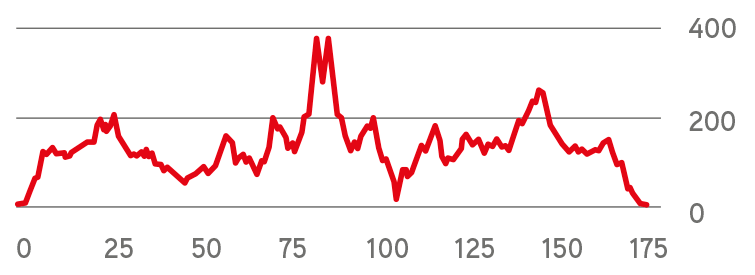
Move along the elevation profile to see where you are on the map.
Food & coffee stops
Tried-and-tested places where cyclists like to stop for coffee, food or water.
-
Café 32 kmBar ca'n Guillem Porreres
A bar with a terrace right on the main square and bike racks in front. Cyclists are especially welcome and it opens at 6:00.
Open in maps ↗ -
Café 52 kmSa Bakery Cafè Manacor
Speciality coffee, cinnamon rolls and everything baked in-house, right on Plaça del Convent; closed on Sundays.
Open in maps ↗ -
Bike shop 96 kmLa Bicicletta Artà
Bike shop with a workshop (Shimano Service Center) – your last chance to sort out a mechanical problem before the climb to the Betlem hermitage.
Open in maps ↗ -
Restaurant 122 kmCa na Bel Petra
Bar with a kitchen right on Plaça Ramon Llull, where cyclists meet in Petra: coffee, gluten-free almond cake, pa amb oli or a baguette. Open daily from 7:00, with about 55 km still to go.
Open in maps ↗
An All-Day Cycling Pilgrimage to Betlem
Route summary:
This trip, which takes you to the pilgrimage destination of Betlem, is one of the most popular cycling routes. It is a more demanding ride due to the long distance and a couple of steep climbs. It should be taken in a group of more experienced cyclists. The whole trip takes between 5.5 and 7 hours depending on your average speed. The terrain is mostly undulating with some short climbs and descents. The most significant of these is the climb towards the pilgrimage destination of Betlem. At the top, you will find a hermitage, which used to serve as a refuge for the local monks. Combined with the breath-taking view, the scenery here is genuinely beautiful. We can take some rest in one of the towns along the way – Llucmajor, Porreres, Manacor, Artá, or Petra. All of them offer historical monuments and picturesque views.
 Cycling route summary:
The initial 30 kilometers has a flat/slightly hilly, leading through Llucmajor to Porreres. Then a pleasant descent to the town of Manacor follows. Next kilometers are more hilly part of the route. At the beginning, few small climbs come on the way to Arta. Then there is an ascent to Bethlehem itself. After few pleasant descents on the route back from Bethlehem, several cascading climbs come in front of the town Petra. You can perfectly compare your remaining power with your friends. The last part of the route is mostly flat. Only between Algaida and Llucmajor you can expect a few short swingy hills.
 Tourist summary:
The route will take you through the flat inland of the north-eastern part of the island. The main point comes after a 5-kilometer climb to the Hermitage of Bethlehem. It offers a number of extraordinary views and historic monuments.
Climbs click to show on the map
- Coll des Pescadors from Artà 5.7 km · Ø 4.6 % · max. 8.4 % · top 374 m km 79–85
- Coll des Pescadors from Ermita de Betlem 1.5 km · Ø 6.7 % · max. 9.3 % · top 374 m km 86–88
Tips from our guides
- Plan a full day: with stops, 177 km takes 6–8 hours. In winter it gets dark around 17:30, so start early and carry a rear light.
- There is no café at the hermitage, and its spring is not a reliable source of drinking water. Eat and fill both bottles in Artà before the climb.
- The Ma-3333 to Betlem is narrow and twisty, with little traffic. Watch out for goats on the road and rental cars whose drivers are admiring the view.
- Past Coll des Pescadors the road drops about 1.5 km to the hermitage. Save some energy: the way back starts with a 1.5 km climb at 6.7%, max 9.3%.
- The open plain between Petra and Algaida offers little shelter from the wind. Ride in a group and take turns at the front on the long way home.
Did you know?
- Petra is the birthplace of Junípero Serra (1713). In 1769 he founded Mission San Diego, the first in today's California, and he was canonized in 2015. source
- Manacor is home to Majorica pearls, a brand founded in 1890 by German engineer Eduard Hugo Heusch. The glass cores get a lustrous coating made partly from fish scales. source
- Betlem was founded on 29 July 1805 by hermits from Sant Honorat on Puig de Randa and the Trinitat near Valldemossa. It overlooks the Bay of Alcúdia. source
Places along the route
-
117 km
Llucmajor
It is the largest city on the island in terms of its wide area, however the town itself has fewer than 12,000 inhabitants (the whole municipality over 40,000). The first historical records of the city date back to the 13th century. Definitely the most interesting historical event is the Battle of Llucmajor. It was a part of the war of independence of the Mallorca Kingdom in 1349.
Important city industry today includes tourism and footwear production.
The most famous monuments of the city are the Town Hall, the Church of St. Michael from the 18th century on Plaça Santa Catalina Tomàs and the monument of James III - Passeig Jaume III. Jaume III. fell in a memorable battle in the war for independence.
-
230 km
Porreres
The city history dates back to the Bronze Age. Arab and Roman settlements. The current city name was given after its conqueror, William of Porreres in 1300.
The main street is Avinguda Bisbe Campins. It is a pedestrian area with many cafés, bars and the Gothic church of Nostra Senyora del Consolacion.
If you like modern art, you might be impressed by the Salvatore Dali exhibition in the town hall. And of course, there is a traditional marketplace as well.
-
350 km
Manacor
Manacor is the second largest city in Mallorca. Traces of settlement can be found from around 2000 BC. You can see the marks of Roman and Moorish settlers. Modern history dates back to 1300, when it got granted the city status.
The main ‘must see’ is the parish church of Nostra Senyora dels Dolors. If you would like to go inside the church, it is better to arrive there in the morning. The doors might be closed in the afternoons. The large pedestrian zone can be explored anytime, but the best is to come over on Monday, when the local market is in full swing. You will find there the traditional stalls and special olive wood products, making Manacor famous.
If you are a tennis fan, you may find it interesting to know that Rafael Nadal is a local native and the mentor of the local Rafael Nadal International Tennis Center.
-
476 km
Artá
The town, located in the northeast of Mallorca. It keeps its traditions and has a number of historical monuments. It is definitely worth mentioning the parish church of Transfiguracio del Senyor. The church dominates the pedestrian zone in the city center.
The main attraction is the local fortress Santuario de Sant Salvador. It lies directly above the city and provides magnificent views of the town Artá and its surroundings.
-
586 km
Ermita de Betlem
The hermitage, founded in 1805, offers many cultural experiences as well as a number of breathtaking views of the northeast coast. The whole complex consists of several buildings and structures, used as a monastery by the monks. The interesting one is, for example, the chapel with a beautiful marble altar.
-
6121 km
Petra
The historical records date back to the 13th century. The town has less than 3,000 inhabitants nowadays.
If you are interested in architecture, don’t miss the church of Esglesia de Sant Pere. The church was built in the Gothic style between the 16th and 18th centuries. You may also like the two squares, Placa del Pare Serra and Placa Ramon Llull.
You can also try to taste the local famous virgin olive oil Tafona de Son Cuixa SL and wine from the Miquel Oliver winery.
-
7129 km
Sant Joan
The historic town, founded in 1300. If you like sport, especially Futsal, you might find interesting that it’s home to the famous Spanish Futsal team Sant Joan C.E.
This town was previously the second residence of King James II.
-
8143 km
Algaida
Algaida has a population of 4,500. The origin of the name can be found in Arabic. It means "the forest".
The first written records date back to 1232. The city's sights are the Mare de Déu de la Pau de Castellitx, pilgrimage chapel and several windmills. The city also has the oldest glass blowing factory in Mallorca. You can still see the local glassmakers producing art objects in the workshop of the Gordiola family.
More routes
All routes →Rides of similar difficulty you might also like.