Route no. 15 · start & finish Can Pastilla
Porto Cristo
- Hard
- 203 km
- 1,430 m
- ≈ 7½–9 h
Map and elevation profile
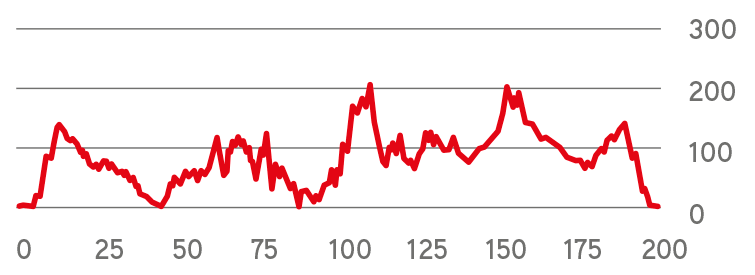
Move along the elevation profile to see where you are on the map.
Food & coffee stops
Tried-and-tested places where cyclists like to stop for coffee, food or water.
-
Café 49 kmBar y Restaurante Estarellas Ses Salines
Bar with a terrace on the church square, about 100 m off the route at km 49: coffee and breakfast, later tapas and paella. Opens at 8:30 (9:00 Fri–Sat), closed on Wednesdays; the well-known Bodega Barahona next door only serves from 1 pm.
Open in maps ↗ -
Café 56 kmSa Plaça Santanyí
Café-restaurant with a terrace on the main square, Plaça Major, about 500 m off the route at km 56: coffee, breakfast or pa amb oli among golden sandstone houses. From 6 am on market days (Wednesday and Saturday), otherwise from 9–9:30 am; closed on Tuesdays.
Open in maps ↗ -
Café 88 kmTacoffee Porto Cristo
Small restaurant serving Mexican food (tacos, quesadillas, vegan options too) and specialty coffee in a pedestrian lane near the harbour, right by the route at km 88. Thu–Mon 12:00–15:30 and evenings, Wednesday evenings only, closed on Tuesdays.
Open in maps ↗ -
Restaurant 137 kmRestaurante Can Biel Felanitx
Down-to-earth restaurant with a daily set menu in Felanitx, about 190 m off the route, listed in the Mallorca Cycling Lab guide – a solid lunch with 66 km still to go. Open daily 8:00–15:30.
Open in maps ↗ -
Café 138 kmCafeteria s'Abeurador Felanitx
Café with a terrace on the edge of the main square, Plaça d'Espanya, about 900 m off the route – a short detour into the centre at km 138: coffee, almond cake and toasts. From 6 am (7 am at weekends); closed on Tuesdays, and only until 3 pm on Sundays.
Open in maps ↗ -
Café 151 kmBar ca'n Guillem Porreres
Family-run bar with a terrace on the main square in Porreres, about 650 m off the route at km 151, with bike racks by the tables; cyclists are welcome. Open daily from 6 am – coffee or pizza before the rolling stretch to Llucmajor.
Open in maps ↗ -
Café 163 kmCafé Colón Llucmajor
Café dating from 1928 with a terrace on the main square, Plaça d'Espanya, about 600 m off the route at km 163 – the last coffee with 40 km to go. Opens at 8:30 and closes at 4–4:30 pm; closed on Tuesdays.
Open in maps ↗
A Pleasant 200-km Ride to the Birthplace of Rafael Nadal
Route summary:
This long ride over the slightly undulating terrain in the east part of the island makes the route to Porto Cristo an ideal endurance-training session. This is a more demanding route. The whole trip takes from 6.5 to 8.5 hours depending on your average speed. The route will take you along the charming shoreline all the way to the port town of Porto Cristo. From there, the ride continues through the slightly undulating terrain in the east part the island. The best places to stop to replenish your energy are in the town of Ses Salines, which is famous for salt mining, the main square in Santanyí, and Porto Cristo, where you can see a beautiful mermaid statue in Calle des San Jorge and the historical Torre des Falcons guard tower. On the way back you ride through Manacor, the island’s second-largest town and the birthplace of Rafael Nadal. For coffee or lunch, stop on the main square in Felanitx, in Porreres or on the picturesque square in Llucmajor, lined with excellent cafés.
 Cycling route summary:
This route will take you along the east coast of the island, starting with a gentle 10-km climb, after which there is flat terrain for about 40 km along the south-east coast of Mallorca taking you to the small town of Santanyí. The roughly 30 km from Santanyí to Porto Cristo are over undulating terrain with short climbs and descents. The road from Porto Cristo has a similar character and takes you to a hight of 200 m above sea level. A pleasant descent to the small town of Manacor follows. An almost 30-km-long and easy ride from Manacor then takes you to Porreres. However, the following 10-km ride between Porreres and Llucmajor requires a bit more effort as there short climbs that often break groups apart. The final part from Llucmajor is all about a pleasant ride with a swift descent, taking you to Can Pastilla.
 Tourist summary:
This route starts in Palma Aquarium and is the second-longest trip in our portfolio. It takes you all the way to the east coast of Mallorca, with the ultimate destination being the picturesque port of Porto Cristo. The ride back leads you through some famous places such as Manacor, Felanitx, Porreres and Llucmajor. This route will give you the opportunity to compare which Mallorcan coast you like better – the east or the west.
Tips from our guides
- 203 km means 6.5–8.5 hours in the saddle. Start early, and in spring and autumn carry front and rear lights – dusk can catch you on the way home.
- Leave with two full bottles: after s'Arenal the Ma-6014 crosses about 40 km of open, shadeless country, and the first real village is Ses Salines at km 49.
- From km 107 to Manacor (about 15 km) the route uses the busy Ma-15 main road. Ride single file, keep right and take extra care at roundabouts.
- Pace the long day: Porto Cristo at km 88 is not even halfway. Eat something every hour and keep reserves for the rolling stretch between Porreres and Llucmajor.
- At Llucmajor (km 163) there are still 40 km to go: the route loops south towards Cala Pi and back along the coast road, with a gentle rise to about 140 m.
Did you know?
- Almost the whole outward leg, from s'Arenal to Porto Cristo, runs on roads built by Republican prisoners in forced labour in 1936–1942, including the Ma-6014, Ma-19 and Ma-4014. source
- Right next to the route in Porto Cristo lie the Coves del Drac. Their Lake Martel is one of the largest underground lakes in the world, and the visit ends with a live concert. source
- Son Servera's Església Nova was begun in 1906 by Joan Rubió, a collaborator of Gaudí. Work stopped for lack of money in 1929, and the roofless church now hosts concerts and weddings. source
Places along the route
-
148 km
Ses Salines
Ses Salines is a town in the far south of the island. The name can be translated as “source of salt”, and salt production has always been part of its history. It is also famous for its local honey.
Near the town you can visit Botanicactus, the largest botanical garden in the Balearic Islands.
-
252 km
Es Llombards
Es Llombards is a charming village with a famous beach called Cala Llombards. The stunning atmosphere of the village shops, bars, restaurants, and markets is fascinating, and it turns into a perfect place to learn about local customs and traditions twice a week – every Wednesday and Saturday.
-
354 km
Santanyi
Every year the creative atmosphere of this town attracts artists from all over the world. In the town’s historic streets you will find all kinds of galleries and workshops.
The locals know each other personally as they often meet in the cosy cafés and wine shops, which are mainly scattered around the town square.
The fort and gate are reminders of the pirate attacks in the past.
-
462 km
S’Alqueria Blanca
This is just a stunning village with a main square where you can find the locally popular bakery, some bars, restaurants, and cafés. If you are fond of Italian cuisine, you simply must stop at the Bacco restaurant to taste its Italian specialities enriched with local vegetables, meat, and fish.
-
588 km
Porto Cristo
Porto Cristo used to be a busy port, close to Manacor, but it’s a quiet resort these days. The town was named after a legend. It tells about a ship found washed away on the beach carrying a crucifix. The second legend tells about an ox carrying a cross and refused to move out of the way from the port. The locals took it as a sign and named the town Porto Cristo.
You can also find a beautiful mermaid statue in the town Calle des San Jorge, or ancient watchtower from 1577, Torre des Falcons, above the hidden cave. There is also an old church in the Plaza del Carme.
It is worth mentioning the caves Coves del Drach ("dragon cave") and Coves dels Hams ("fish-hook caves").They are just a few kilometers far in front of the port itself.
-
693 km
Safari Zoo
Safari Zoo is a great combination of safari and fun park. You can find there over 600 animals. Unfortunately, you can’t ride a bike inside, but you can easily jump on the safari train and get a nice tour around the park.
-
7100 km
Son Servera
This village is situated in the northeast of Mallorca, in the area known as Llevant. The first historical records of this place date back to the beginning of the 13th century. The village got its name based on the legend of a deer, who once passed through this area.
The calm atmosphere with classic architecture comes to life especially on Fridays, when the local market opens.
-
8115 km
Sant Llorenc des Cardassar
Sant Llorenç is a quiet place. If you walk through, you will notice many windmills around. The village still maintains its original state. Don’t miss the 14th-century Baroque church of Sant Llorenç on the main Plaça Nova square.
You can visit the remains of the Son Pereto Basilica, dating back to the 5th century, free of charge. The basilica was probably destroyed by fire. Archaeologists from various institutes are carefully examining it up till today.
The historic railway building of Sant Llorenç is also worth visiting. It was built in 1921 as part of the Manacor-Artá railway line.
The most famous local historical figure is the writer Salvador Galmés i Sanxo (1876), well-known regional advocate of independence.
-
9123 km
Manacor
Manacor is the second largest city in Mallorca. Traces of settlement can be found from around 2000 BC. You can see the marks of Roman and Moorish settlers. Modern history dates back to 1300, when it got granted the city status.
The main ‘must see’ is the parish church of Nostra Senyora dels Dolors. If you would like to go inside the church, it is better to arrive there in the morning. The doors might be closed in the afternoons. The large pedestrian zone can be explored anytime, but the best is to come over on Monday, when the local market is in full swing. You will find there the traditional stalls and special olive wood products, making Manacor famous.
If you are a tennis fan, you may find it interesting to know that Rafael Nadal is a local native and the mentor of the local Rafael Nadal International Tennis Center.
-
10137 km
Felanitx
It’s a local, regional town. Its history dates back to the Bronze Age. This place is famous for its wine industry. There were more than 60 distilleries, in this area, in 1749.
Capers are also very famous locally. The main daily attraction is the city center market with a rich selection of local products.
The main historical monuments are the Castell de Santueri, the Monastery of San Salvador with the adjacent fortress and the Church of San Miguel.
-
11150 km
Porreres
A small town with a seemingly sleepy atmosphere, but the appearance is deceptive. Its history dates back to the Bronze Age. Arab and Roman settlements bring in mind wells, used to be used by humans or animals. The current city name was given after its conqueror, William of Porreres. A sad historical event is a small revolution called "famous", during which the town hall burned down with 600 years of historical documentation. It coincides with the fall of Queen Isabella II in 1868.
The main street is Avinguda Bisbe Campins. It is a pedestrian area with many cafés, bars and the Baroque church of Nostra Senyora de la Consolació.
If you like modern art, you might be impressed by the Salvatore Dali exhibition in the town hall. And of course, there is a traditional marketplace as well.
-
12162 km
Llucmajor
It is the largest city on the island in terms of its wide area, however the town itself has fewer than 12,000 inhabitants (the whole municipality over 40,000). The first historical records of the city date back to the 13th century. Definitely the most interesting historical event is the Battle of Llucmajor. It was a part of the war of independence of the Mallorca Kingdom in 1349.
Important city industry today includes tourism and footwear production.
The most famous monuments of the city are the Town Hall, the Church of St. Michael from the 18th century on Plaça Santa Catalina Tomàs and the monument of James III - Passeig Jaume III. Jaume III. fell in a memorable battle in the war for independence.
More routes
All routes →Rides of similar difficulty you might also like.